September 30, 2026
Corridor Champions: Lauren McGaughey and Mairead Meyer – Delivering world-class digital connectivity
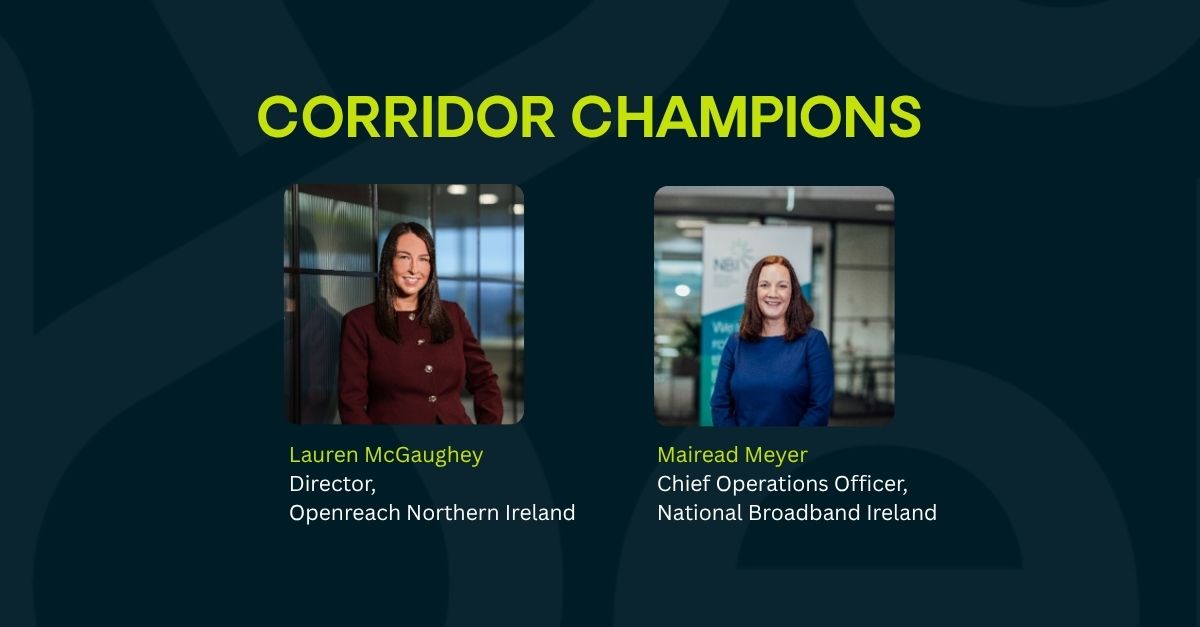
Each quarter, the ‘Corridor Champion’ series highlights leaders and organisations making a significant contribution to the development of the Dublin-Belfast Economic Corridor (DBEC). In this edition, we feature Lauren McGaughey, Director of Openreach Northern Ireland, and Mairead Meyer, Chief Operations Officer at National Broadband Ireland, both active members of the DBEC Industry Advisory Panel.
High-speed digital connectivity is no longer simply a communications service – it is critical infrastructure underpinning how people live, work and do business. Across the Dublin Belfast Economic Corridor, investment in next-generation broadband is helping create the conditions for a more connected, productive and innovative economy, with an ambition to achieve 95%+ high-speed broadband coverage by the end of 2026.
For Lauren and Mairead, that ambition is about more than coverage figures. It is about ensuring that businesses, communities and individuals – from the region’s principal cities to its towns, villages and rural areas – can participate fully in the digital economy.
Openreach NI is already seeing strong progress, with its Full Fibre network covering 93% of premises across Northern Ireland, and it is on track to reach 97% coverage in the next few years.
Lauren is clear that: “Digital infrastructure is now seen as essential infrastructure: it helps people and organisations connect, work, learn and grow.”
For Lauren, involvement with the DBEC Industry Advisory Panel provides an opportunity to bring Openreach NI’s first-hand experience and practical insight to the wider conversation around connectivity in the Corridor.
“Openreach NI understands what it takes to deliver and maintain critical digital infrastructure at scale — and, importantly, the difference that high-quality connectivity can make to businesses, communities and the wider economy.”
For National Broadband Ireland, the importance of connectivity is equally fundamental.
Mairead is in no doubt that: “High-quality digital infrastructure is now as fundamental to economic and social participation as roads, electricity and water. It means reliable, future-proof connectivity that people and businesses can depend on every day.”
For Mairead that commitment also has a personal dimension. Over the past 20 years, she has worked and travelled regularly along the DBEC region, both north and south of the border, giving her a first-hand view of how it has evolved.
Mairead is particularly interested in seeing that towns, villages and rural communities between Dublin and Belfast share in the region’s growth, including in regard to visibility and investment.
As the organisation responsible for delivering Ireland’s National Broadband Plan, this aligns closely with National Broadband Ireland’s purpose, which is to bring high-speed fibre broadband to rural towns, villages, businesses, farms and homes.
As Mairead explains: “Through DBEC’s Industry Advisory Panel, I can bring that experience to an agenda for growth and development across the entire DBEC region. I want people living and working anywhere along the route to share in the opportunities the DBEC region creates.”
That connectivity is particularly important to the Corridor, which links two major cities, Dublin and Belfast, with a network of towns, communities and enterprise locations in between. Ensuring that investment reaches beyond the main urban centres is central to the region’s future economic potential.
High-speed broadband enables remote and hybrid working, online learning and access to digital public services, while giving businesses the capacity to adopt cloud technologies, collaborate across borders and reach customers in national and international markets.
As Mairead puts it: “Strong digital connectivity removes geography as a constraint.”
For businesses, that can mean access to a wider pool of talent, customers and technologies; for residents, greater choice over where they live and work; and for communities, new opportunities to participate in a growing digital economy.
The investment case is also changing. Both providers highlight the growing importance of digital infrastructure to companies considering where to locate or expand. Reliable, scalable connectivity is increasingly expected alongside traditional considerations such as transport, power, property and skills.
For the DBEC region, the cross-border dimension adds another important opportunity. The two providers emphasise the need for strong connectivity on both sides of the border, reflecting the reality that businesses and communities increasingly experience the Corridor as one connected economic geography.
The next challenge is therefore to turn connectivity into inclusive growth. Coordinated action between government, local authorities, regulators and industry – including efficient planning, road openings and infrastructure-access processes – can help accelerate delivery and minimise disruption.
Looking ahead, the opportunity is significant. As the Corridor moves towards near-universal high-speed broadband coverage, the infrastructure can become a platform for business growth, inward investment, innovation, productivity and more balanced regional development.
Lauren sums up the opportunity: “The biggest opportunity is to make the Corridor an even easier place to grow a business. Strong digital infrastructure can help firms reach wider markets, give people more choice about where they work, as well as make the region more attractive to investors. The key is making sure those benefits reach communities all along the route.”
For Mairead, the next phase is about ensuring that the benefits reach every part of the Corridor: “Over the next five years, the Corridor can attract new investment while enabling more indigenous businesses, entrepreneurs and skilled workers to thrive in towns and rural communities along the route.”
With cities, towns and rural communities increasingly connected, the Corridor has an opportunity to demonstrate how world-class digital infrastructure can support a genuinely integrated, cross-border economy – and create new possibilities for investment, enterprise and quality of life over the next five years.